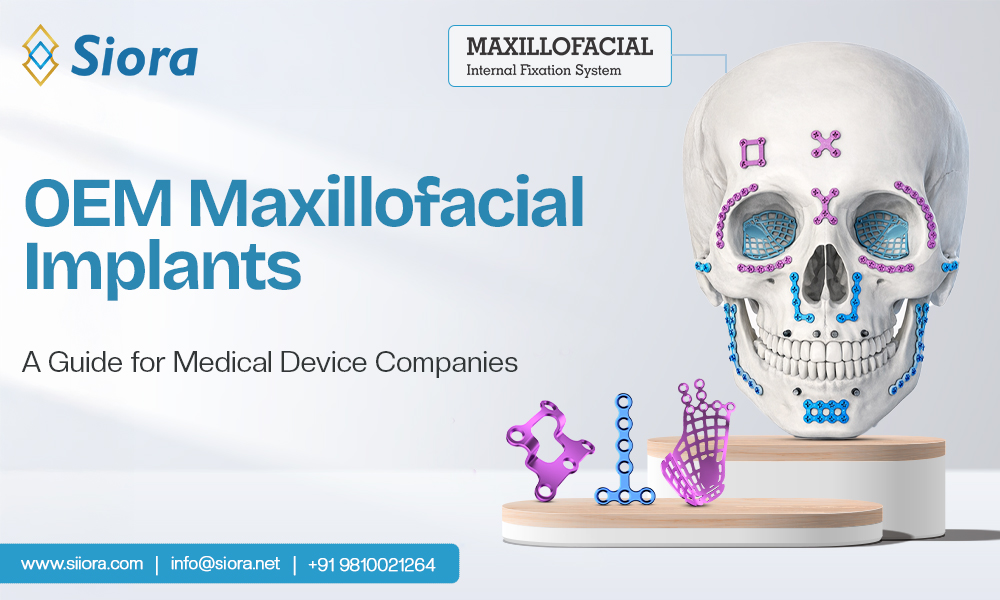
Maxillofacial surgery requires implants that are designed with precision, consistency, and clinical requirements in mind. For medical device companies, developing an in-house manufacturing facility for every implant can require significant investment in machinery, skilled manpower, quality systems, and regulatory processes. This is where OEM maxillofacial implants can offer a practical alternative.
Under an OEM arrangement, a specialized implant manufacturer produces maxillofacial implants according to the specifications, drawings, branding, packaging, and quality requirements of another medical device company. This allows companies to expand their product portfolio without managing every stage of manufacturing themselves.
What Types of Implants Can Be Manufactured?
The maxillofacial segment covers a wide range of surgical applications. An OEM partner may manufacture products such as locking plates, reconstruction plates, mandibular plates, orbital plates, mini plates, midface plates, and other fixation components.
Implant dimensions, hole configurations, plate profiles, screw compatibility, and material specifications can be customized depending on the intended application. For example, low-profile implants may be preferred for certain facial areas where soft-tissue coverage is limited.
Commonly used materials include commercially pure titanium and titanium alloys because of their strength, corrosion resistance, and established use in implantable medical devices.
Why Medical Device Companies Choose OEM Manufacturing
Flexibility is one of the key reasons why OEM manufacturing is preferred by companies. A medical device company can work with an experienced manufacturer to develop or source products without building an entirely new production line.
Faster Product Expansion
OEM manufacturing can help companies introduce additional maxillofacial products to their portfolio more efficiently. Instead of investing years in developing manufacturing capabilities, companies can leverage an established production setup.
Consistent Manufacturing Quality
Experienced OEM manufacturers generally have established processes for machining, finishing, cleaning, inspection, packaging, and documentation. Consistency is particularly important for medical implants, where dimensional accuracy and surface quality can directly affect product performance.
Branding and Customization
OEM programs can support private-label requirements. Depending on the agreement, products may be supplied with the customer’s brand name, packaging design, product codes, labels, and documentation.
What Should Companies Check Before Selecting an OEM Partner?
Choosing an OEM supplier should involve more than comparing product prices. Medical device companies should examine the manufacturer’s quality management system, manufacturing capabilities, material traceability, inspection procedures, and documentation practices.
It is also important to understand whether the manufacturer can maintain consistent tolerances across production batches. Companies should ask about prototype development, design support, testing, packaging, sterilization requirements, and change-control procedures where applicable.
Regulatory documentation is another important consideration. The OEM partner should be capable of providing the technical and quality records required to support the customer’s regulatory and market-entry obligations.
Building a Reliable OEM Partnership
A successful OEM relationship starts with clear communication. Product drawings, material grades, dimensional requirements, surface finish, packaging specifications, inspection criteria, and labeling requirements should be agreed upon before production begins.
Prototype evaluation can also help identify design or manufacturing issues before larger-scale production. Regular quality reviews and controlled documentation further help maintain consistency as the product line grows.
Conclusion
OEM maxillofacial implants can give medical device companies a practical way to expand their surgical product range while reducing the burden of establishing complete manufacturing capabilities internally. The right OEM partner can provide manufacturing expertise, customization, quality control, and production scalability under one arrangement.
For companies entering or expanding in the maxillofacial market, the focus should be on finding an OEM orthopedic device manufacturer that combines technical capability with reliable quality systems and a clear understanding of medical device requirements. A carefully selected OEM partnership can support long-term product development while helping companies respond more effectively to changing market needs.

